

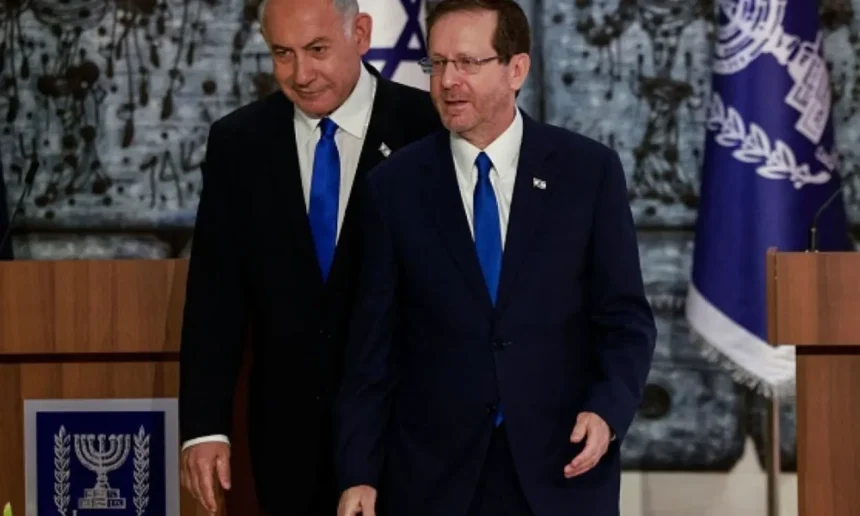
Israeli Prime Minister Benjamin Netanyahu reportedly rejected repeated US requests for President Isaac Herzog to attend the unveiling of US President Donald Trump’s “Board of Peace” in Davos, Switzerland. According to Axios reporter Barak Ravid, the White House asked Netanyahu’s office several times to allow Herzog to sit on the stage and sign the Board of Peace charter at the World Economic Forum ceremony. The US administration had hoped Israel would be represented by a senior figure at the launch, which was framed as a central element of Trump’s Gaza peace and reconstruction initiative.
As reported by Axios and summarized by Israeli outlets, the White House invitation to join the Board of Peace was formally extended to Israel along with dozens of other states, with leaders or their representatives asked to attend the Davos event. Netanyahu, who has accepted Trump’s invitation for Israel to join the board, did not travel to Switzerland because of an International Criminal Court arrest warrant and Switzerland’s stated intention to enforce it. With Netanyahu absent from Davos but Herzog present for the wider forum, US officials sought to have the Israeli president stand in as Israel’s representative at the ceremony.
Why did Netanyahu block Herzog’s participation?
Context and reactions
According to Axios, Netanyahu argued that Trump’s invitation was addressed to him personally and not to Herzog, and therefore vetoed the president’s participation on the Davos stage. Sources cited in that reporting described multiple phone calls between senior White House officials and Netanyahu’s team in the days before the ceremony, characterizing some of the exchanges as “tense and difficult.” The Times of Israel, reporting on the same Axios account, said the requests from Washington continued until just hours before the signing event, but Netanyahu held firm in his refusal.
US officials reportedly believed that placing Herzog on stage with Arab and Muslim leaders would signal that Trump’s Gaza plan and the Board of Peace had broad support from both regional states and Israel. Israeli media noted that Jerusalem has expressed displeasure with Washington’s decision to appoint senior officials from Turkey and Qatar to the Gaza Executive Board, a key operational arm of the wider Board of Peace, which is expected to play a leading role in overseeing postwar Gaza. Against that backdrop, Netanyahu’s refusal to allow Herzog to appear at the launch added another point of friction to already complex US–Israel coordination on Gaza.
Supporting details and internal Israeli tensions
Israeli reports state that the disagreement over Herzog’s presence has created strains between the Prime Minister’s Office and the President’s Residence, as well as between Netanyahu’s office and the White House. The Times of Israel noted that despite the way the Axios account was framed, Herzog is not formally subordinate to the prime minister and does not legally require Netanyahu’s permission to attend international events of this kind. Nonetheless, in practice, Netanyahu’s stance effectively blocked Herzog from appearing on stage at the Board of Peace ceremony.
The Jerusalem Post, citing the same Axios reporting, also highlighted Trump’s remarks at the launch, in which he said that once the Board of Peace is fully formed, its members would be able to “do pretty much whatever we want to do” in coordination with the United Nations. Israeli outlets pointed out that Netanyahu accepted Israel’s seat on the board despite “serious reservations,” with one official quoted as saying he felt he had little choice given Israel’s heavy reliance on the American president. The combination of those reservations and the tensions over Gaza governance appears to have contributed to Netanyahu’s reluctance to let Herzog visibly endorse the initiative in Davos.
What are the implications and possible next steps?
The reported clash over Herzog’s attendance underscores broader unease in Jerusalem over aspects of Trump’s Gaza initiative and the governance structure built around the Board of Peace and its Gaza Executive Board. US officials had hoped that a visible Israeli role at the launch would strengthen the perception that the plan is backed by both Israel and key Arab and Muslim states; Israel’s absence instead highlighted lingering disagreements over the role of Turkey, Qatar and other actors in postwar arrangements. The episode may complicate ongoing US–Israel discussions on how the Board of Peace framework and related bodies will operate in Gaza and how responsibilities will be shared.
Within Israel, the report is likely to fuel debate about Netanyahu’s handling of relations with both the US administration and the country’s own ceremonial presidency. Questions may continue about whether keeping Herzog off the Davos stage helped Israel safeguard its interests around Gaza governance or instead deepened diplomatic friction with Washington at a sensitive moment. For now, the key confirmed development is that Netanyahu rebuffed US efforts to have Herzog represent Israel at Trump’s Board of Peace unveiling, leaving the launch without any senior Israeli figure on stage and signaling unresolved tensions over the parameters of Trump’s Gaza initiative.